
A moonphase watch does one thing most watches don't: it tracks the moon. Not metaphorically. A small aperture on the dial shows the current lunar phase — new moon, first quarter, full, last quarter — updating automatically as the 29.5-day cycle moves forward. It's one of the oldest complications in watchmaking, and one of the most visually distinctive.
If you've seen a watch with two small golden moons on a rotating disc behind a shaped window, that's a moonphase. Here's how the mechanism works, how to read and set it, and why this centuries-old complication still belongs on a modern wrist.
What Is a Moonphase Complication?
In watchmaking, a "complication" is any function beyond telling the time. A date window is a complication. A chronograph is a complication. A moonphase display is a complication — and one of the most mechanically elegant.
The core mechanism is surprisingly simple. A disc sits beneath the dial, printed or engraved with two identical moons on opposite sides. This disc is driven by a 59-tooth gear. A single tooth advances the disc once per day, completing one full rotation every 59 days — or two complete lunar cycles of 29.5 days each.
As the disc rotates, a shaped aperture on the dial reveals one moon at a time. The curved edges of the aperture frame the visible portion of the moon, mimicking the waxing and waning you'd see if you looked up. When the full disc of the moon is visible through the window, it's a full moon. When the aperture shows only a thin crescent, you're looking at the first or last days of the cycle.
The 59-tooth gear is the key. The actual lunar cycle is 29 days, 12 hours, 44 minutes, and 2.8 seconds — call it 29.53 days. A 59-tooth gear divides to 29.5 days per moon, which means the display drifts by only about 44 minutes per month. In practical terms, a standard moonphase complication loses one day of accuracy roughly every two years and seven months. A quick correction once a year keeps it precise enough that you'd never notice the difference.
How to Read a Moonphase Display
Reading a moonphase is intuitive once you understand the four key positions.
New moon. The aperture shows no moon — the disc is positioned so neither moon face is visible. The window appears dark or shows only the background of the disc (often a deep blue or black field with printed stars). This corresponds to the start of the lunar cycle, when the moon sits between the Earth and the sun and isn't visible in the night sky.
Waxing crescent to first quarter. Over the next seven days, a crescent of the moon gradually enters the right side of the aperture. By day 7.4, exactly half the moon is visible. This is the first quarter — the moon is one-quarter of the way through its full cycle, and the right half of its face is illuminated.
Full moon. By day 14.75, the complete disc of the moon sits centered in the aperture. The entire face is visible. In the sky, this is when the moon is on the opposite side of the Earth from the sun, fully illuminated.
Waning to last quarter and back to new. The moon continues to slide through the aperture. The left side begins to disappear first. By day 22, you're at the last quarter — half the moon is visible again, but now it's the left half. Over the final week, the crescent narrows until the moon exits the aperture entirely, and the cycle starts again with the second moon on the disc entering from the other side.
Most moonphase displays position the complication at 6 o'clock, though some place it at 12 o'clock or integrate it into a subdial. The aperture is typically arch-shaped — two semicircles joined at the top, creating the optical illusion of a moon growing and shrinking behind a curved horizon.
How to Set a Moonphase Watch
Setting a moonphase takes a few minutes and a clear night — or a quick search for the current lunar phase.
Step 1: Find the current moon phase. Look it up on any weather app, astronomy site, or lunar calendar. You need to know where the moon is today — new, full, or how many days past the last new moon.
Step 2: Pull the crown to the moonphase setting position. On most watches, this is a dedicated crown position or a separate pusher on the case side. Check your watch's manual — each caliber handles this differently. Some use a recessed pusher at 2 o'clock or 10 o'clock that you press with a stylus or pin.
Step 3: Advance the disc to match. Press the pusher or turn the crown to advance the moonphase disc one day at a time. Each press or click moves the disc by one tooth on the 59-tooth gear. Advance it until the moon displayed in the aperture matches the current phase. If today is a full moon, center the moon disc so the complete face is visible in the aperture. If you're three days past new moon, advance three clicks from the new-moon position.
Step 4: Set the time and date normally. Once the moonphase matches reality, push the crown back to the time-setting position and set the hour, minute, and any calendar functions. The moonphase will now track automatically from this point.
Step 5: Correct periodically. If you wear the watch daily, it will stay accurate for over two years before drifting by a single day. If the watch stops (because you haven't worn it or the battery died), simply repeat the process — look up today's moon, advance the disc to match, and you're set.
One important rule: never adjust the moonphase while the watch is between roughly 9 PM and 3 AM on the dial. During these hours, the calendar mechanism is often engaged, and forcing the moonphase pusher can damage internal gears. Set it during daytime hours to be safe.
A Brief History of Moonphase Watches
Moonphase displays predate wristwatches by centuries. The earliest known astronomical clocks — like the one built by Giovanni de' Dondi in Padua around 1364 — tracked lunar cycles along with planetary movements. These were room-sized mechanisms, not portable instruments, but the principle was identical: a geared disc rotating behind a shaped window.
The complication moved to pocket watches in the 17th and 18th centuries, produced by makers like Abraham-Louis Breguet. By the 19th century, moonphase pocket watches were common among those who could afford complicated horology. The moon wasn't decorative — for sailors, farmers, and travelers, knowing the lunar cycle had practical value for navigation, tides, and agricultural planning.
When wristwatches took over from pocket watches in the early 20th century, the moonphase came along. Patek Philippe produced some of the most celebrated early moonphase wristwatches, including the reference 1526 from 1941 — the first serially produced perpetual calendar wristwatch with moonphase. These were rare, expensive, and made in small numbers.
The quartz revolution of the 1970s nearly killed mechanical moonphase watches, along with much of traditional Swiss watchmaking. But the mechanical renaissance of the 1980s and 1990s brought them back. Brands like Jaeger-LeCoultre, Blancpain, and A. Lange & Sohne produced moonphase models that helped reestablish the complication as a mark of refined watchmaking.
For decades, the moonphase remained a complication found almost exclusively in watches priced well above $1,000 — often above $5,000 or $10,000. The gearing, the disc printing, the aperture shaping, and the assembly all added cost. It was a luxury-tier feature.
That changed as movement technology improved and brands outside the traditional Swiss establishment began producing moonphase watches at accessible price points. Today, reliable quartz-driven moonphase movements deliver accurate lunar tracking without the cost overhead of a fully mechanical gear train, making the complication available to a much wider audience without sacrificing the visual impact or functional accuracy that made it compelling in the first place.
The Paul Rich Moonphase Collection
We built the Moonphase Star Dust II to put a real lunar complication on your wrist without the markup that usually comes with it.
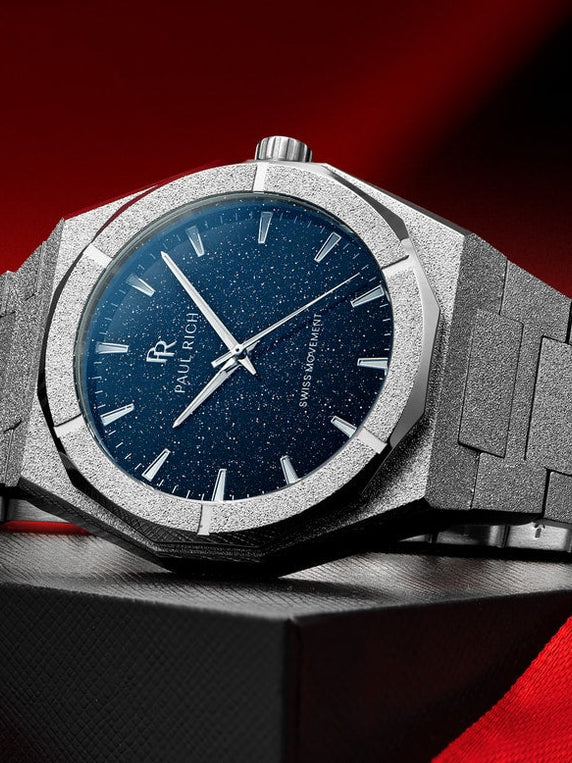
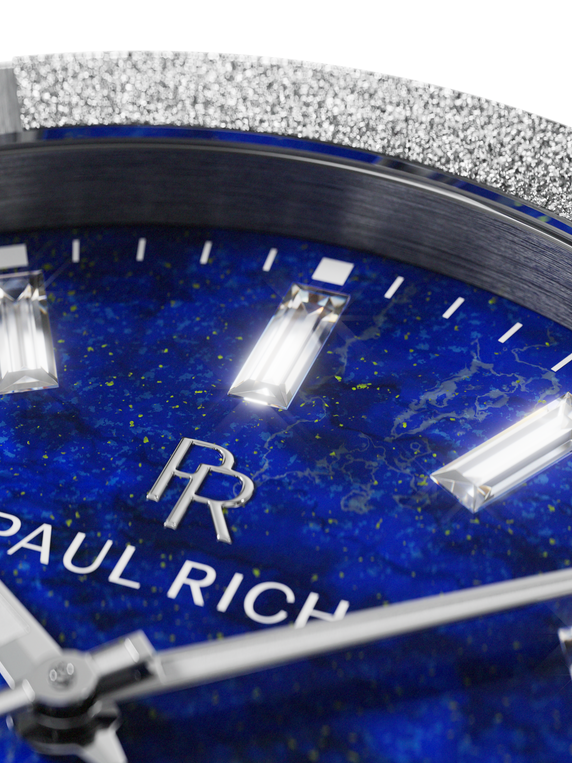
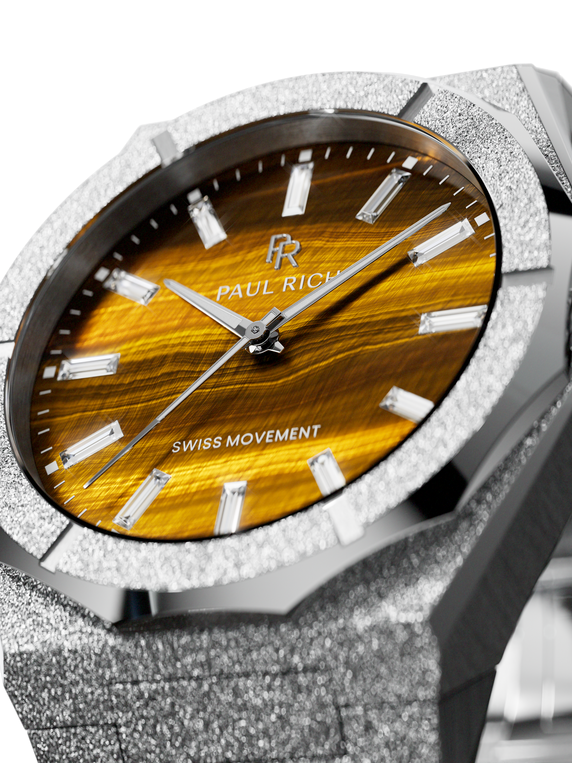
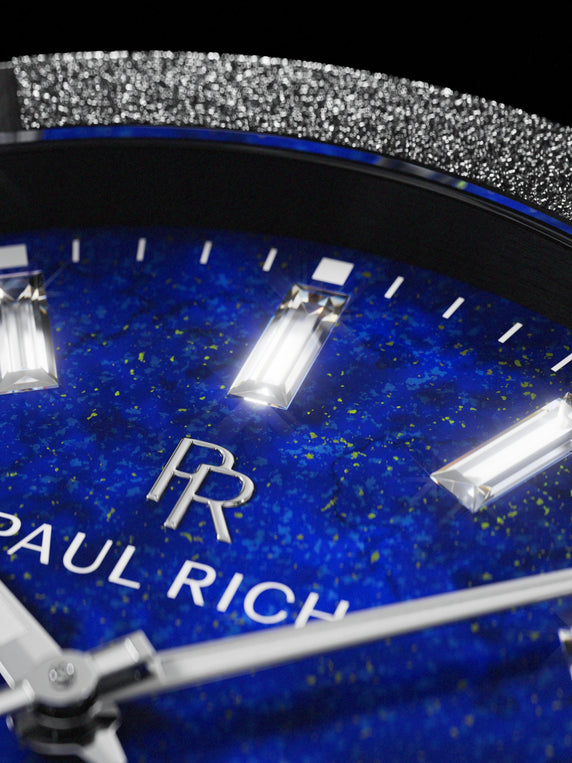
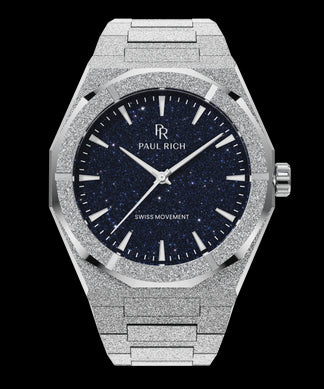
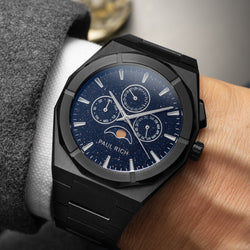
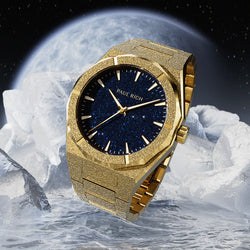
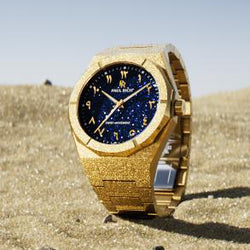
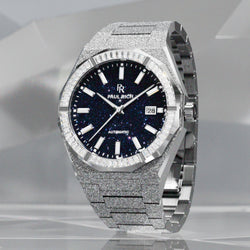
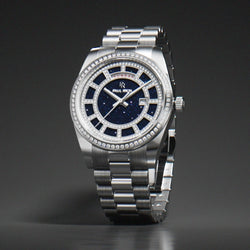
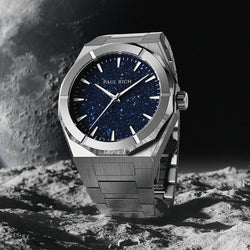
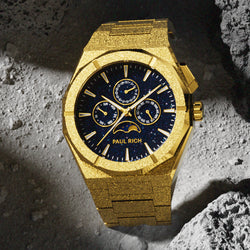
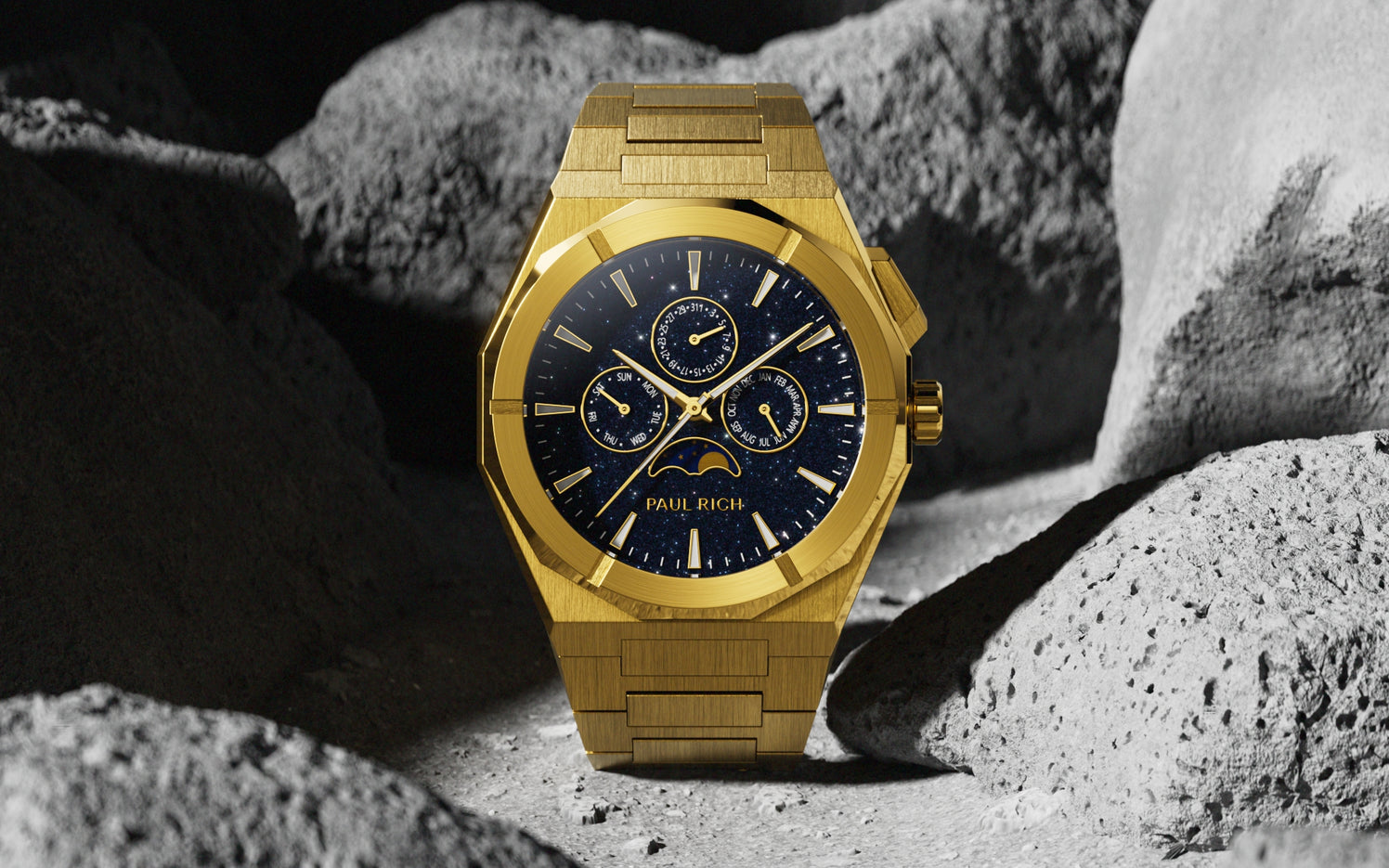
The dial is genuine aventurine — a natural stone flecked with copper and mica inclusions that scatter light differently depending on the angle. No two dials reflect light the same way. The moonphase aperture sits at 6 o'clock, with three additional subdials tracking day, date, and month across the face. It's a functional layout: you can read the lunar phase, the day of the week, the date, and the month without touching the crown.
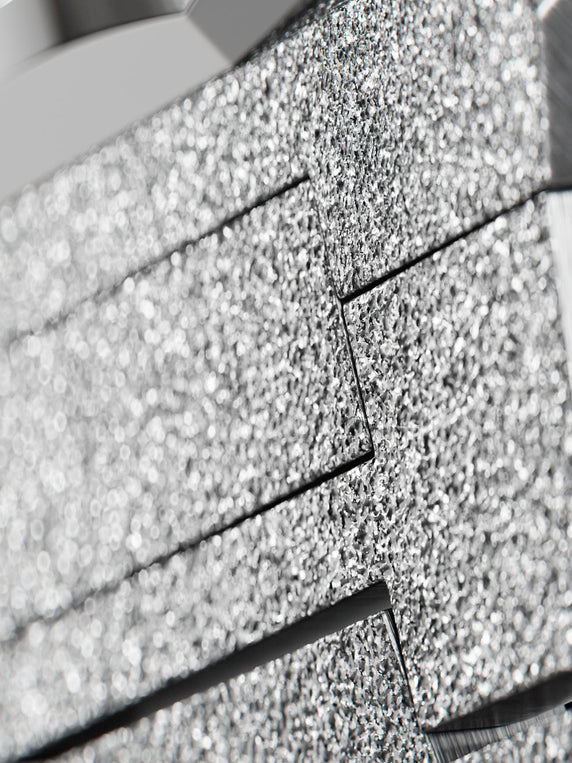
The 43mm stainless steel case is finished with clean, directional brushing — a matte texture that adds a controlled glow without the mirror-polish fingerprint problem. Case thickness is 11mm, lug-to-lug is 48.5mm, and the strap width is 20mm. Mineral crystal glass protects the dial. Water resistance is rated at 5 ATM, which covers rain, pools, and everyday water exposure.
Inside, a Swiss quartz movement handles both timekeeping and the moonphase advance. Quartz here isn't a compromise — it means the watch runs continuously without winding, the moonphase stays synchronized as long as the battery lives, and accuracy sits within seconds per month rather than seconds per day.
The collection comes in four case finishes:
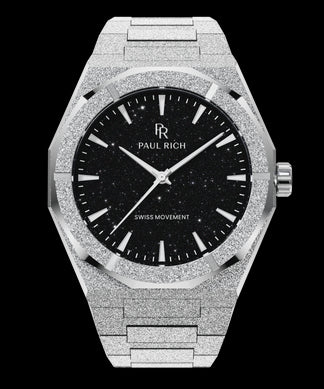
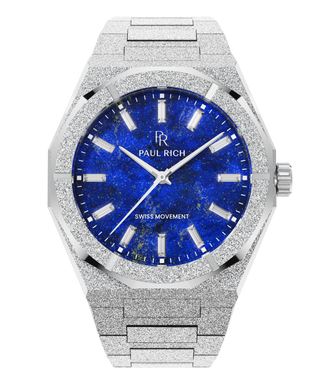
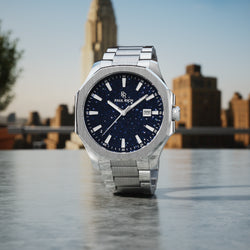
- Moonphase Star Dust II Silver — brushed silver case, blue aventurine dial, $379
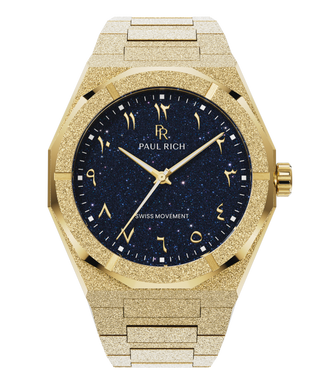
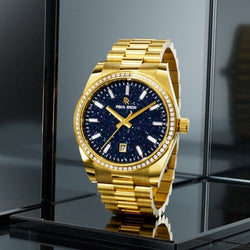
- Moonphase Star Dust II Gold — brushed gold case, blue aventurine dial, $379
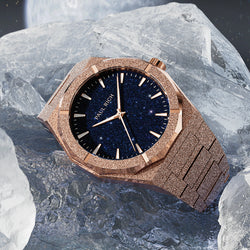
- Moonphase Star Dust II Rose Gold — brushed rose gold case, blue aventurine dial, $379
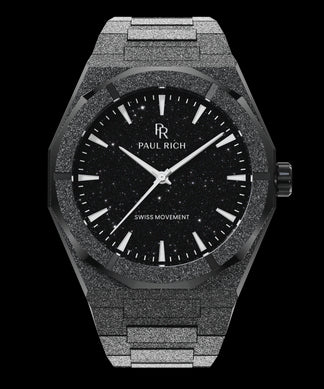
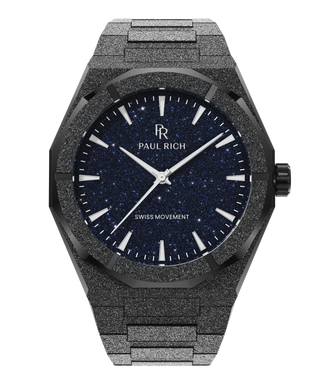
- Moonphase Star Dust II Black — brushed black case, blue aventurine dial
Each shares the same Swiss quartz movement, aventurine dial, and moonphase complication. The difference is the case and bracelet finish — pick the metal tone that fits your rotation.
Moonphase watches have carried a premium for centuries because the complication requires precision gearing, careful disc alignment, and a dial layout that integrates the aperture without crowding the face. The Moonphase Star Dust II delivers that same mechanical principle — the 59-tooth gear, the dual-moon disc, the shaped aperture — in a package built for daily wear at a price that doesn't require a second mortgage.
Why the Moonphase Still Matters
Every watch tells the time. A moonphase watch tells you something else: where you are in a cycle that's been running for 4.5 billion years. There's a reason this complication has survived from 14th-century astronomical clocks to modern wristwatches — it connects a mechanical object on your wrist to something happening 238,900 miles above your head.
It's also one of the most visually active displays in watchmaking. Unlike a date window that changes once per day or a chronograph that sits idle until you press a button, a moonphase is always moving. The disc advances daily, the visible shape of the moon shifts, and the display looks different every time you check it. On an aventurine dial, where the stone itself changes character with the light, the moonphase adds another layer of movement to an already dynamic surface.
And there's the practical side. If you spend any time outdoors — fishing, camping, surfing, photography — the lunar cycle affects tides, wildlife activity, and ambient light conditions. A moonphase on your wrist gives you that information at a glance, without pulling out a phone.
The moonphase is the oldest astronomical complication still in regular production. It's survived the quartz crisis, the smartwatch era, and every trend cycle in between. That kind of persistence doesn't happen by accident. It happens because the complication does something genuinely useful and does it in a way that looks good on the dial.