
What Does "Iced Out" Actually Mean?
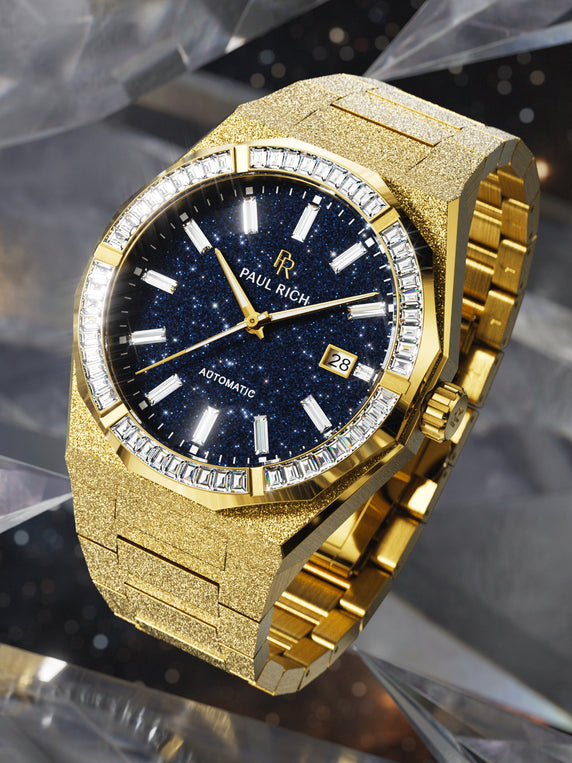
An iced-out watch is covered in stones — diamonds, cubic zirconia, moissanite, or crystal — set across the bezel, dial, bracelet, or all three. The term comes from the way densely packed stones catch light, creating a surface that looks like crushed ice under direct sun.
The original iced-out watches were custom pieces. A jeweler would take a Rolex or AP, remove the factory bezel, and replace it with a diamond-paved version — sometimes adding stones to the dial, lugs, and bracelet links. These "bust-down" customs ran $20,000 to $100,000+, depending on stone quality and coverage.
Today the term covers a wider range: factory-set diamond watches from brands like Rolex and Cartier, aftermarket customs, and a growing category of watches that achieve the iced-out look through alternative materials — lab-grown diamonds, moissanite, CZ, and frosted metal finishes. Not all are created equal. Here's how to tell the difference.
Real Diamonds vs CZ vs Moissanite: The Honest Comparison
Three stones dominate the iced-out market. Each has a different chemical makeup, a different light behavior, and a very different price point. Understanding the differences is the fastest way to stop overpaying — or getting scammed.
Natural Diamonds
Carbon, compressed over billions of years. A natural diamond scores 10 on the Mohs hardness scale — the hardest natural material on Earth. It refracts light with a brilliance index of 2.42, producing the classic "white fire" that diamond buyers pay for.
The catch: natural diamonds in watch bezels are graded the same way as ring stones — cut, clarity, color, carat. A fully iced-out Rolex with VS-quality natural diamonds can run $50,000–$150,000. And unless the jeweler provides per-stone certification, you have no way to verify what you actually got.
Cubic Zirconia (CZ)
Synthesized zirconium dioxide. CZ looks like diamond to the naked eye but behaves differently under magnification and testing. Key differences:
- Hardness: 8–8.5 Mohs vs diamond's 10. CZ scratches more easily over time, and heavy daily wear shows it within months.
- Weight: CZ is roughly 1.7x heavier than diamond at the same size. A 5mm CZ weighs about 0.80 carats versus 0.50 for diamond. Pick up two watches side by side and you can feel the difference.
- Light dispersion: CZ has higher dispersion (0.066 vs 0.044), which means more rainbow flashes. It looks "too colorful" compared to diamond — experienced eyes catch this immediately.
- Longevity: CZ clouds over time. The surface develops a milky haze with extended UV exposure and skin contact. After 1–2 years of daily wear, the difference is visible.
CZ is the standard filler in watches under $200. It's not inherently bad — it's just not diamond, and any seller calling it "diamond-grade" or "diamond-quality" is being deliberately misleading.
Moissanite
Silicon carbide, originally discovered in a meteor crater by Henri Moissan in 1893. Lab-grown moissanite is the engineered middle ground: harder than CZ, more brilliant than diamond, and a fraction of the cost of either.
- Hardness: 9.25 Mohs — second only to diamond. It won't cloud, haze, or scratch under normal wear. This is the key difference from CZ.
- Refractive index: 2.65 vs diamond's 2.42. Moissanite bends more light, producing more fire and brilliance per carat. Under direct light, it outperforms diamond in raw sparkle.
- Diamond tester: Moissanite passes most thermal diamond testers because its thermal conductivity is close to diamond's. Only a dedicated moissanite tester (which measures electrical conductivity) can distinguish them.
- Certification: Reputable moissanite is graded by gemological labs like IGI (International Gemological Institute), with per-stone reports covering cut, clarity, and color quality.
Moissanite doesn't pretend to be diamond. It's a distinct gemstone with different optical properties — and in many measurable ways, it outperforms diamond for brilliance. The honest pitch isn't "diamond alternative." It's "a harder, brighter stone at a lower price."
How to Spot Fake Iced-Out Watches
The iced-out market is full of watches that look the part on Instagram but fall apart within weeks. Here's what to check before you spend.
The Fog Test
Breathe on a stone. Real diamonds and moissanite dissipate heat almost instantly — the fog disappears in 1–2 seconds. CZ and glass hold moisture longer, staying fogged for 4–5 seconds. It's not definitive on its own, but it catches the worst fakes immediately.
The Weight Test
CZ weighs 1.7x more than diamond at the same dimensions. Glass weighs even more. If an "iced-out diamond" watch feels unusually heavy for its size, the stones probably aren't what the seller claims. This is harder to test without a comparison piece, but anyone who has held a real diamond-set watch will feel the difference.
Hallmarks and Stamps
Legitimate precious metal watches carry hallmarks — 750 for 18k gold, 925 for sterling, 316L for surgical stainless steel. No hallmark, no confidence. Check the case back, clasp, and inner lugs. Blank metal on an expensive watch is a red flag.
Documentation
Real diamond watches come with stone certification — GIA, IGI, or equivalent — specifying total carat weight, clarity range, color grade, and cut quality. If the seller can't produce paperwork, assume the stones are CZ. "Certificate of authenticity" printed by the brand itself isn't the same as independent lab certification.
Price Reality Check
Diamonds cost money. A bezel with 1+ carats of VS-clarity, F-G color natural diamonds can't exist on a $200 watch. It can't exist on a $500 watch. If the price seems too good for "real diamonds," it is. Always.
The more productive question isn't "are these real diamonds?" — it's "what stone am I actually getting, and is the price fair for that material?"
The Smart Alternative: Frosted Finishes and Lab-Grown Stones
For decades, the iced-out equation was simple: natural diamonds or nothing. If you couldn't afford a $30,000 bust-down, you bought CZ and hoped nobody looked too close. That equation broke when material science caught up — and it caught up fast.
Three developments changed the game:
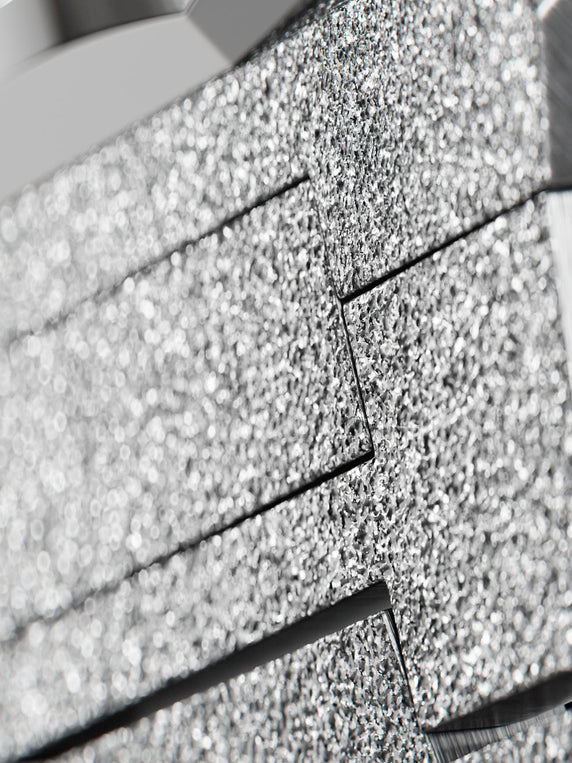
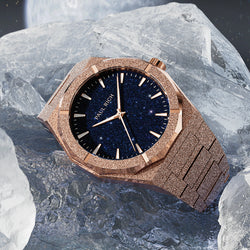
Frosted metal finishes. A process that cuts thousands of micro-facets into stainless steel, creating a surface that scatters light like crushed ice — without any stones at all. The effect is permanent, built into the metal itself. It doesn't cloud, loosen, or fall out because there's nothing to fall out. You get the iced-out visual from the case and bracelet alone.
Lab-grown moissanite. Identical optical properties to mined moissanite, grown in controlled conditions. Higher refractive index than diamond, 9.25 Mohs hardness, and available with full IGI certification — the same lab that certifies stones for major jewelry houses. Per-stone grading means you know exactly what you're getting: cut quality, color, clarity, transparency.
Lab-grown diamonds. Same carbon crystal structure as mined diamonds, same hardness, same brilliance. The only difference is origin: a lab instead of a mine. They're graded identically by GIA and IGI, and they cost 60–80% less than mined equivalents at the same quality.
These aren't compromises. A frosted steel case with moissanite stones catches more light per square millimeter than most natural diamond settings — because the metal itself is doing half the work.
Four Ways to Get the Iced-Out Look — Without Getting Burned
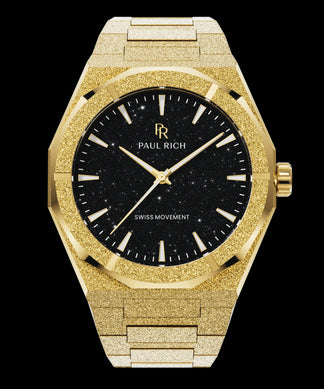
Hand-Set CZ Pave: Crown Legacy ($299)
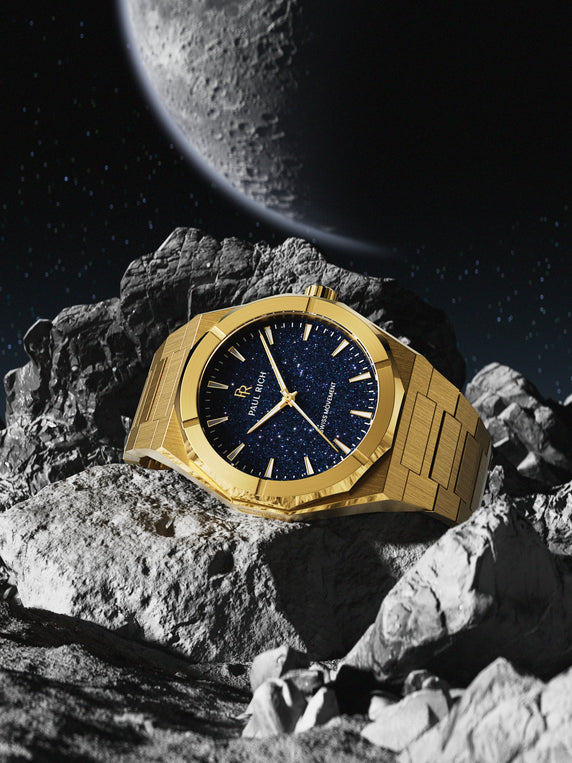
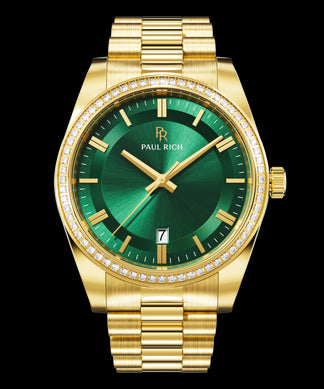
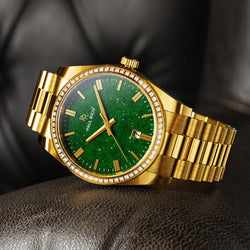
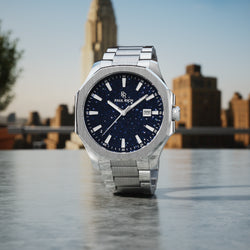
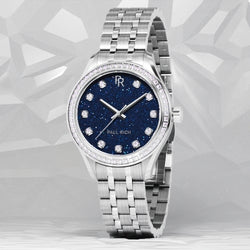
The entry point. The Crown Legacy packs a full pave of hand-set cubic zirconia across the bezel in a tight geometric pattern, paired with a deep blue aventurine stone dial. Gold-tone hands and applied markers sit inside the stone setting — not dropped on top — keeping the time readable while the bezel throws light with every move of your wrist. A jubilee-style bracelet with polished edges and solid wrist weight finishes the look.
CZ at this price is honest. You're getting a well-constructed pave setting on a Japanese quartz watch with real aventurine. Nobody's pretending these are diamonds — and the visual impact at arm's length is the same.
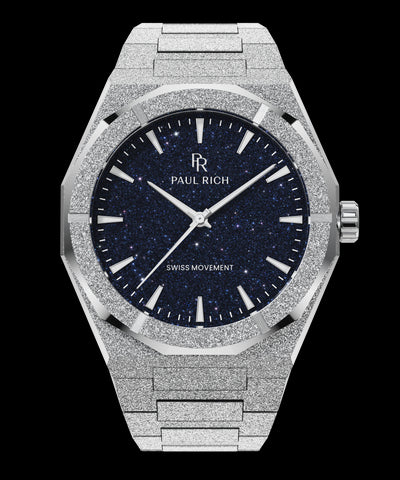
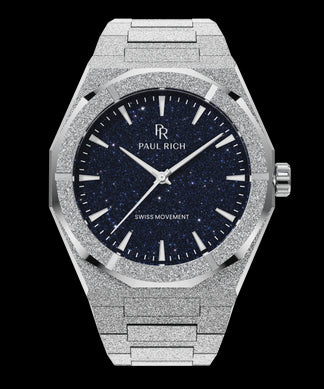
Diamond-Dust Frosted Finish: Frosted Star Dust II ($389)
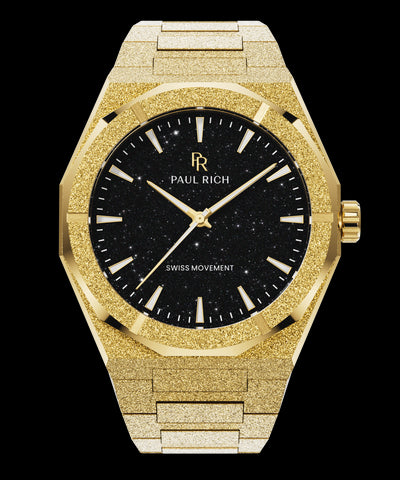
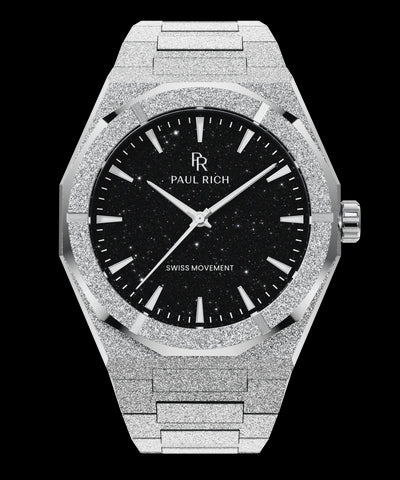
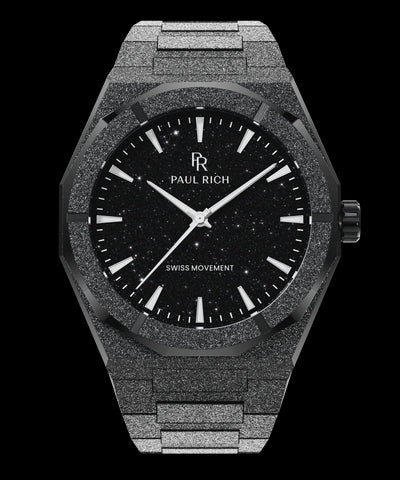
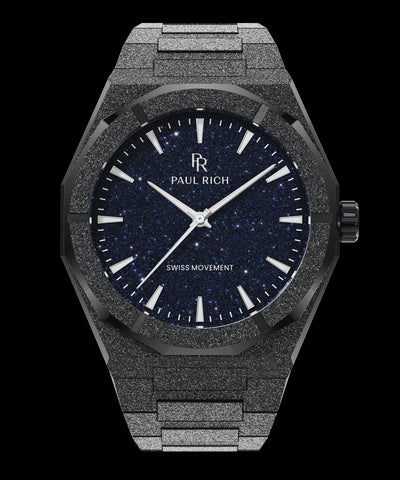
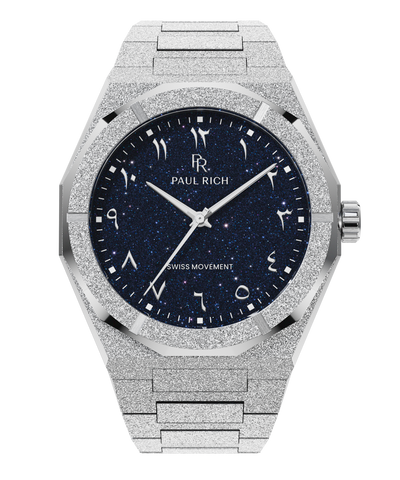
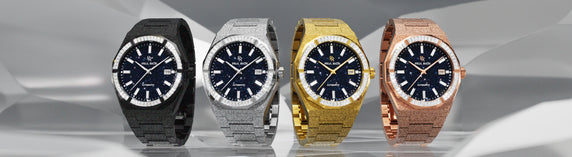
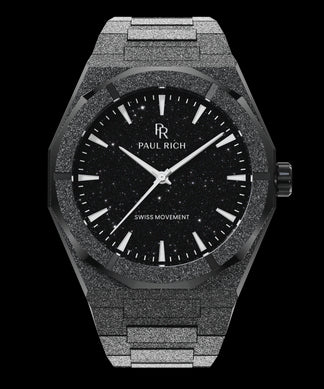
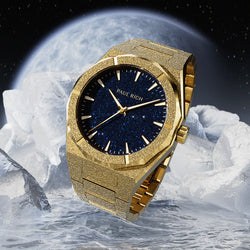
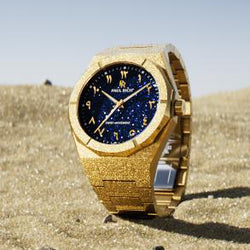
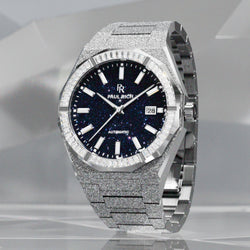
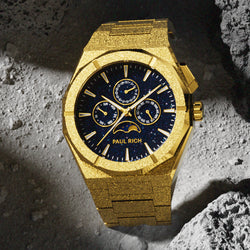
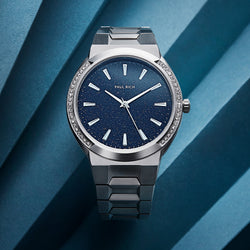
No stones at all. The 43mm case is sculpted with thousands of diamond-cut facets — each one catching light like dust frozen mid-spark. The effect reads as iced-out from across the room, but it's built into the steel itself. Nothing to loosen, nothing to cloud.
Underneath the frosted case sits an aventurine dial — natural stone with suspended metallic crystals that shift color depending on the light angle. The combination of frosted metal and aventurine creates two separate layers of light behavior: scattered surface flash from the case, deep mineral shimmer from the dial.
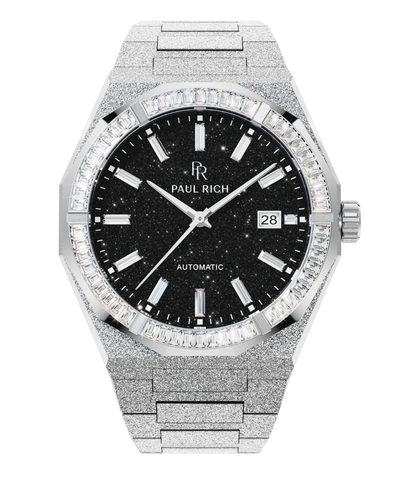
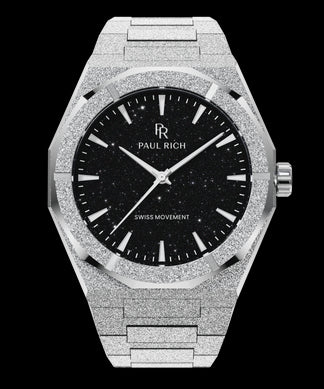
IGI-Certified Moissanite: Moissanite Frosted Star Dust II ($849)
This is where it gets serious. 5.67 carats total weight of hand-cut moissanite covering both bezel and dial in a continuous pave field — the density of light you normally see only in full diamond settings costing 10x more. Every stone is graded by IGI: Colorless, Transparent, Excellent Color Quality.
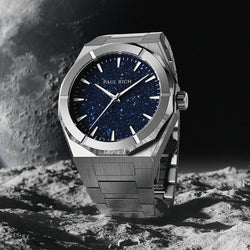
The stones sit against a black aventurine dial — a natural glass filled with microscopic metallic crystals — engineered specifically for contrast. Against that deep, mineral-black base, moissanite behaves differently. The fire is stronger. The reflections are colder. The entire surface reads like a night sky under high magnification, with the pave layer acting as a second constellation built on top of the first.
The 43mm frosted case adds a third layer: thousands of micro-facets scattering light even when the stones aren't in direct sun. Sapphire-coated crystal and 5 ATM water resistance complete the build. Available with Swiss quartz or automatic movement.
Passes the diamond tester. Certified by the same lab that grades stones for major jewelry houses. Under $900.
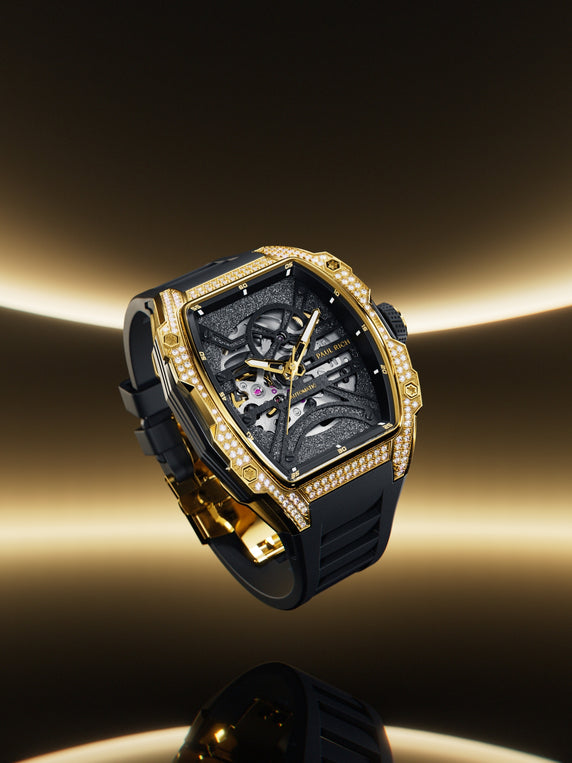
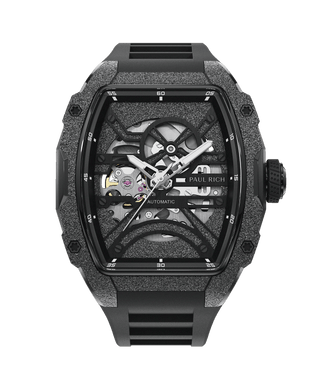
Lab-Grown VVS Diamonds: Diamond Astro Skeleton ($1,499)
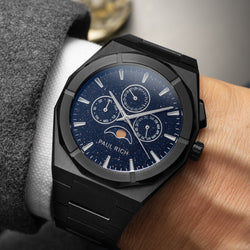
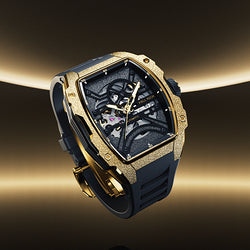
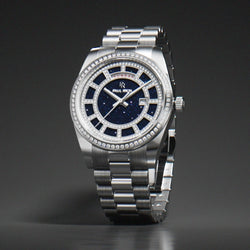
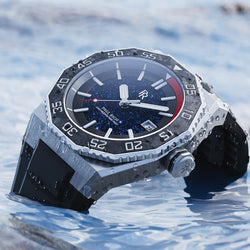
The real thing — grown in a lab instead of a mine. The bezel carries hand-set, lab-grown VVS diamonds that throw light in every direction. But the Diamond Astro doesn't stop at the bezel: look through the skeleton dial and open case back, and you'll see every gear and spring working in perfect rhythm — an automatic movement visible from both sides.
Lab-grown diamonds are chemically identical to mined diamonds. Same carbon lattice, same 10 Mohs hardness, same brilliance. The difference is where they formed and what they cost. At $1,499, you're getting a fully skeletonized automatic watch with real VVS diamonds — a combination that would cost $10,000+ from traditional luxury brands.
5 ATM water resistance and a soft, anti-static black silicone strap make it wearable daily — not just a display piece.
The Bottom Line: Buy the Material, Not the Marketing
The iced-out watch market runs on one trick: making you feel stupid for asking questions. "Real diamonds" with no certification. "Premium quality" with no specs. "Luxury-grade" with no definition of what that means.
Here's the filter that cuts through all of it:
- What stone is it? Diamond, moissanite, CZ, or crystal. There's no shame in CZ at $299 — there's shame in CZ marketed as diamond at $2,000.
- Is it certified? IGI, GIA, or equivalent independent lab — not a piece of paper the brand printed themselves.
- What's the setting method? Hand-set stones in individual prongs hold better than glued stones in channels. Ask.
- What's the case material? 316L stainless steel is the baseline. Anything below that (alloy, base metal, "mineral composite") will corrode, discolor, and irritate skin within months.
- Does the price match the material? If someone is selling you "VVS diamonds" for $200, the stones aren't VVS and they probably aren't diamonds.
The smartest iced-out purchase isn't always the most expensive one. It's the one where you know exactly what you're getting — and the price reflects the material, not the markup.
Natural diamonds still sit at the top for hardness and resale value. But for raw visual impact — the light, the flash, the presence on the wrist — moissanite and frosted finishes deliver more per dollar than anything else on the market. The technology exists. The certifications exist. The only question is whether you're paying for what's on the watch, or what's on the label.