
Rose Gold Watches for Men: The Complete Guide
Rose gold used to be a women's metal. That's what the industry said. Then the watch world caught up with what menswear designers already knew: a warm copper-gold alloy on a man's wrist reads as confident, not soft. The tone does something steel and yellow gold can't — it sits between warm and cool, dresses up without looking overdressed, and pairs with skin tones that typically fight other metals.
This guide covers what you need to know before buying a men's rose gold watch — from the metallurgy behind the finish to styling, and where the market sits at every price point.
Why Rose Gold Is the Power Move for Men's Watches
Rose gold is an alloy, not a plating. Traditional rose gold mixes pure gold with copper and a small amount of silver. The copper gives it that distinct pinkish warmth — more copper, more red; less copper, more subtle blush. In watchmaking, 18K rose gold (75% gold, roughly 22% copper, and a bit of silver) is the standard for high-end solid-gold cases.
What makes it work on men's watches is the warmth of that copper content. Yellow gold reads bright and conspicuous. White gold and platinum lean cool and neutral. Rose gold sits in the middle — present without dominating. On a dark dial, rose gold markers and hands create contrast that draws the eye without screaming for attention. On lighter dials, it adds depth that steel simply doesn't match.
The versatility comes down to undertone. Rose gold complements a wide range of skin tones — from fair to deep. It looks equally natural on a pale wrist in winter and a tanned arm in summer. Because the tone reads as neither overtly dressy (like yellow gold) nor clinical (like steel), a rose gold watch can move between a business meeting and a weekend dinner without feeling out of place.
There's also a scarcity factor. Walk into any room and count the watches: steel, maybe a few yellow golds, the occasional all-black. Rose gold still registers as a deliberate choice — not the default. That's part of its appeal.
Rose Gold PVD vs. Solid Gold: What You're Actually Paying For
Here's where most rose gold watch guides get vague. There are three main ways a watch achieves a rose gold look, and the differences in cost, durability, and longevity are significant.
Solid Rose Gold
The case and bracelet are machined from actual rose gold alloy — typically 18K (75% gold). This is what Rolex, Audemars Piguet, and Patek Philippe use. The color goes all the way through. Scratch it, and the exposed metal underneath is the same rose gold. The tradeoff: weight and price. An 18K rose gold case adds considerable heft (gold is dense — 19.3 g/cm3 vs. steel's 8.0 g/cm3), and the material cost alone pushes watches well into five figures. A Rolex Day-Date in Everose gold starts around $38,000.
Rose Gold Plating (PVD / IP)
This is how most men's rose gold watches under $2,000 achieve their color. PVD stands for Physical Vapor Deposition — the watch case (usually stainless steel) is placed in a vacuum chamber and bombarded with ionized particles of the coating material. The result is a thin but hard layer of rose-gold-toned material that bonds to the steel at a molecular level. Unlike cheap gold plating (the kind that flakes off a $30 gas station watch), PVD coatings bond mechanically to the substrate. They resist scratches better than traditional electroplating, and they don't peel — they wear gradually over years of contact.
Good PVD coatings last 3-5 years of daily wear before showing visible thinning on high-contact areas like bracelet clasp edges and the underside of lugs. That's a realistic number, not a marketing promise. Will it eventually show steel underneath? On a $300-500 watch worn every day, probably — after several years. The same money in solid gold gets you nothing. In PVD, it gets you a watch that looks the part for years.
The practical takeaway: if you're shopping for a men's rose gold watch under $1,000, you're shopping for PVD-coated stainless steel. That's not a compromise — it's how the industry works at this price point. The quality difference between a $100 rose gold watch and a $400 one often comes down to coating thickness, base steel grade (316L vs. cheaper alloys), and finish work. Higher-quality coatings layer multiple materials — sometimes including real gold particles — to hit a richer, more accurate hue. Cheap coatings tend toward an overly pink or orange tone that fades fast.
How to Style a Rose Gold Watch
The reason rose gold works across dress codes is its neutral warmth. It doesn't clash with cool tones the way yellow gold can, and it doesn't disappear into dark outfits the way steel does. Here's how to think about it by occasion.
Related reading: How to Match a Watch to Your Outfit
Casual
Rose gold adds just enough contrast to simple fits. A white t-shirt, dark jeans, and clean sneakers — a rose gold watch on the wrist makes the outfit look intentional instead of thrown together. The warm tone pairs naturally with earth tones: olive jackets, tan chinos, brown leather boots. One rule worth following: don't mix rose gold with yellow gold accessories. A rose gold watch and a silver belt buckle coexist fine. Rose gold and a yellow gold chain look like two outfits fighting each other.
Business
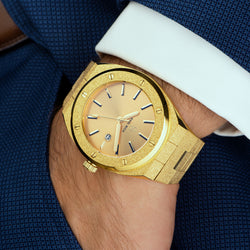
This is where rose gold really earns its keep. Navy and charcoal suits are the bread and butter of professional wardrobes, and rose gold provides a warm accent that stands out against both without overstepping. The key is dial color. A dark dial — aventurine blue, black, or deep green — against a rose gold case reads as grounded and deliberate. A rose gold watch on a rose gold bracelet with a matching suit creates a clean, pulled-together line from cuff to wrist.
One practical note: if your office leans conservative, a rose gold watch with a smaller case (38-40mm) reads more traditional. For more creative or client-facing roles, a 42-43mm rose gold case makes a sharper impression.
Formal
Black tie and rose gold is one of the best-kept pairings in men's dressing. The warmth of rose gold against a black tuxedo creates a contrast that yellow gold and steel can't replicate — warm enough to be noticeable, muted enough to stay appropriate. If you're wearing a tux, go with a clean dial and a bracelet rather than a leather strap. The all-metal look keeps the formality level right.
For weddings, rose gold has become the go-to for groomsmen gifts because it photographs well against navy, grey, and black suits — it picks up light without creating hot spots in flash photography the way polished steel can.
Best Rose Gold Watches at Every Price Point
The rose gold watch market spans from under $100 to six figures. Here's an honest breakdown of what you get at each tier.
Under $200
Fashion watches with basic quartz movements and thin PVD coatings. Brands like MVMT, Vincero, and Fossil operate here. They look good out of the box, but coating longevity is the weak point — expect visible wear within 1-2 years of daily use. The bracelet finishing is where you'll notice the price most: loose links, light weight, clasps that don't lock with confidence. A low-risk entry point if you want to test whether rose gold works for your wardrobe.
$200 - $500
This is where the market gets interesting. Better PVD processes, heavier cases, more refined bracelet construction, and — critically — real materials on the dial side. You start seeing aventurine stone dials instead of printed patterns, sapphire-coated crystals instead of bare mineral glass, and automatic movements as an option alongside quartz. Coating quality at this tier holds up 3-5 years of regular rotation. Brands here include Paul Rich, Tissot (some models), Seiko Presage, and Orient.
Related reading: Best Watches Under $500 | Best Watches Under $300
$500 - $2,000
Higher-end PVD with better base materials. Hamilton, Longines, and Frederique Constant offer rose gold-plated models here with Swiss movements and exhibition casebacks. At the top end, you may find gold-capped cases (thicker layer of actual gold over steel) that outlast standard PVD. The watch at this price should feel noticeably heavier and more refined — crisp date changes, smoother bracelet articulation, finishing you can appreciate with a loupe.
$2,000+
The transition zone into solid gold. Tudor, Omega, and TAG Heuer offer bi-metal construction (steel case, gold bezel) in the $2,000-$10,000 range, while fully solid 18K rose gold starts above $10,000. At the top, you get proprietary alloys: Rolex Everose adds platinum to prevent copper oxidation, Omega's Sedna Gold uses palladium for color stability. At this level, rose gold isn't just a color — it's an engineered material. These watches are investment pieces with secondary market values that hold or appreciate.
Paul Rich Rose Gold Collection: What's in the Range
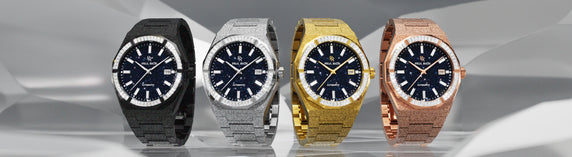
We build rose gold watches across several collections, each with a different design language and price point. Here's what's currently in the lineup and what separates them.
Related reading: Are Paul Rich Watches Good?
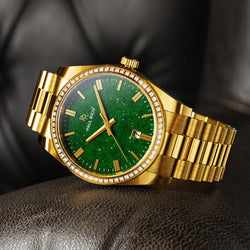
Crown Legacy Rose Gold — Aventurine Blue ($299)
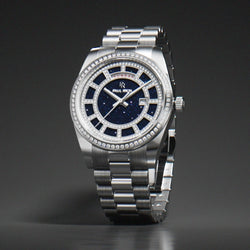
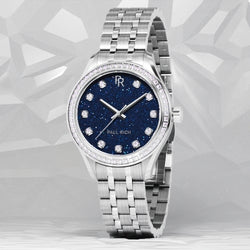
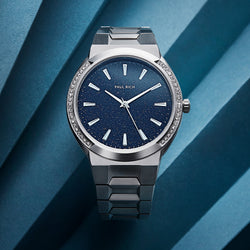
The Crown Legacy is a 40mm rose gold watch built around a full pave design — handset cubic zirconia stones covering the bezel and hour markers in a tight geometric pattern. The dial underneath is deep blue aventurine — natural quartz stone with mineral inclusions that scatter light differently with every movement of your wrist. Day-and-date display sits inside the stone setting, not dropped on top as an afterthought. The jubilee-style bracelet has polished edges and fluid links with solid wrist weight. Japanese quartz movement inside.
At $299, the Crown Legacy is the entry point into the rose gold lineup. The 40mm case size keeps it versatile — it reads dressy enough for a suit and restrained enough for daily wear. The pave bezel adds a layer of visual interest that a plain rose gold bezel can't match.
Star Dust II Rose Gold ($339)
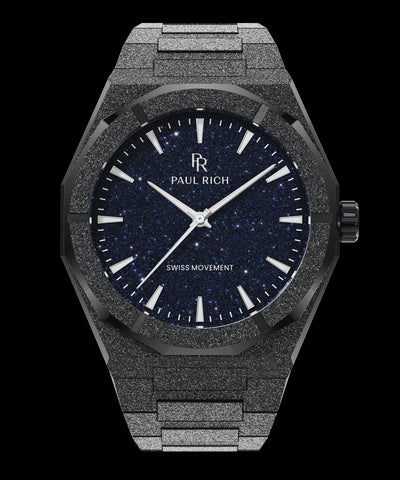
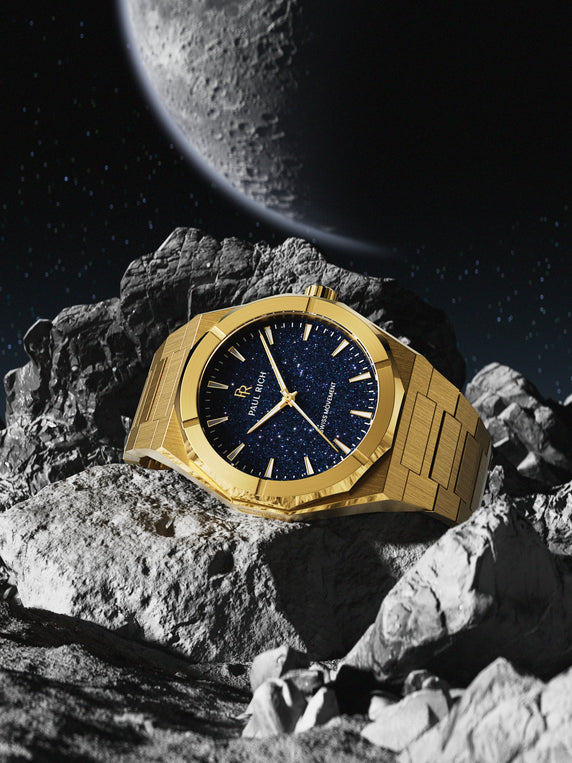
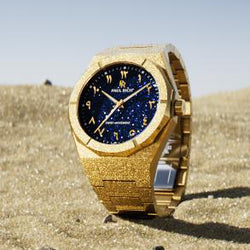
The Star Dust II uses a 43mm stainless steel case with a deep blue aventurine dial — the same natural quartz with mineral inclusions that give it that scattered-light-against-a-night-sky effect. Rose gold case and bracelet in a brushed finish. Mineral crystal glass. Quartz movement. The Star Dust II is the clean-lined option — no stones on the bezel, no complications beyond time. If you want a rose gold watch that leads with the aventurine dial and a confident case size, this is it.
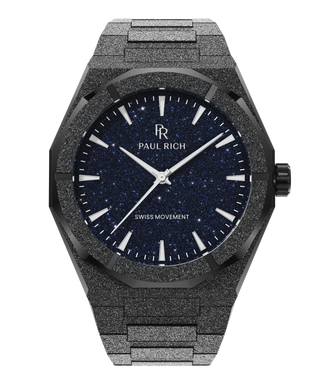
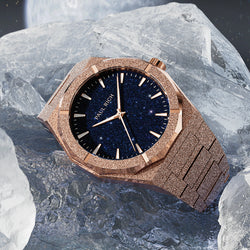
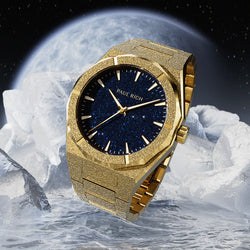
Frosted Star Dust II Rose Gold (from $389)
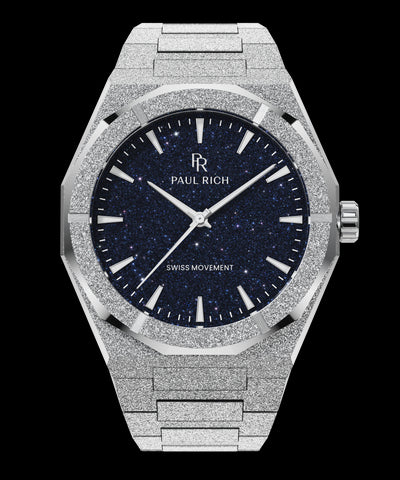
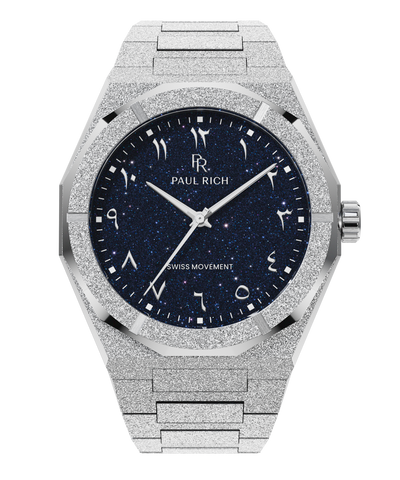
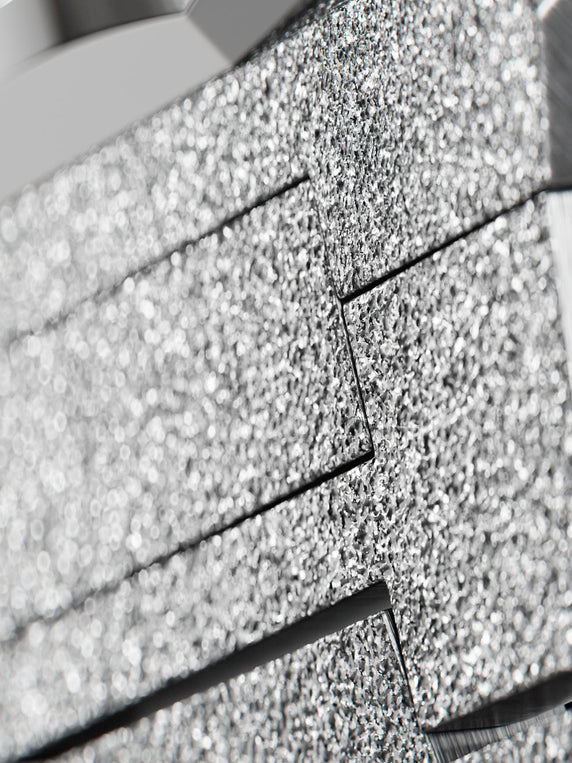
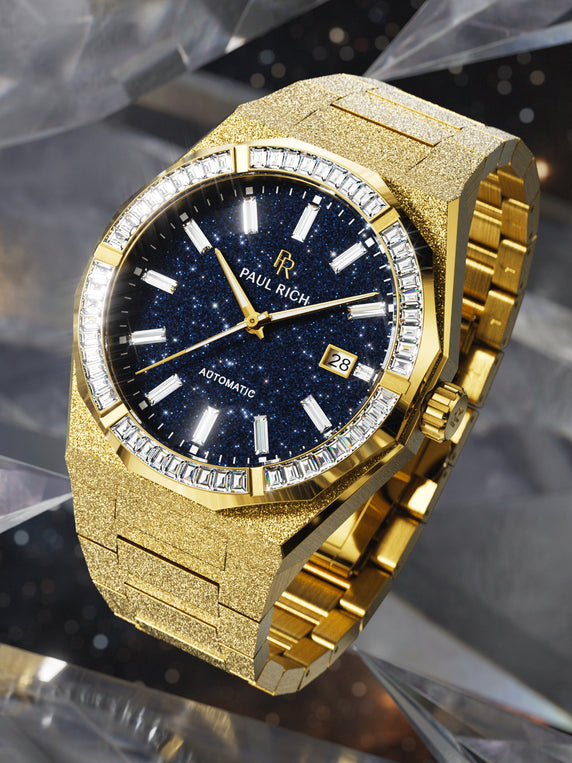
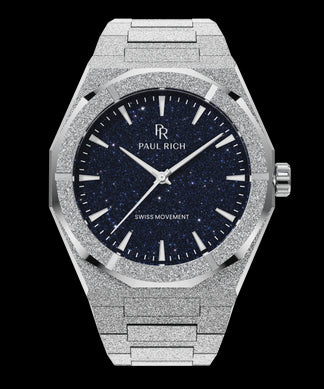
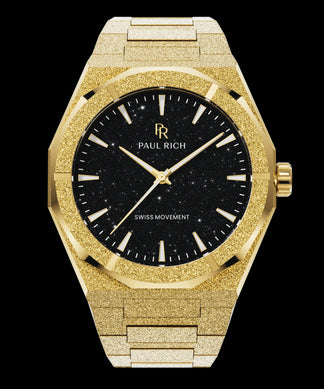
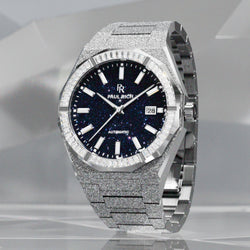
Same 43mm case. Same aventurine blue dial. The difference is the case and bracelet finish: the Frosted Star Dust uses a diamond-cutting process that carves thousands of micro-facets into the stainless steel surface. The result is a texture that catches light like fine dust frozen mid-spark — visible in person from across a room. Available in quartz ($389) and automatic ($549). The automatic version adds a sapphire crystal caseback so you can see the movement running.
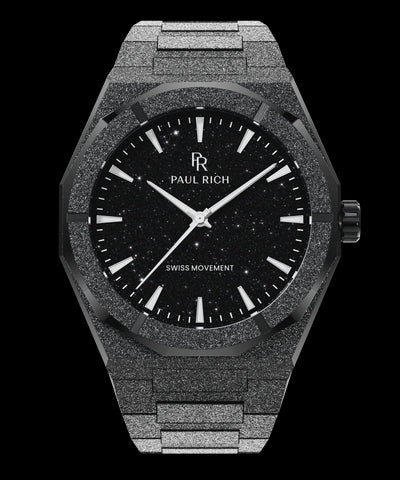
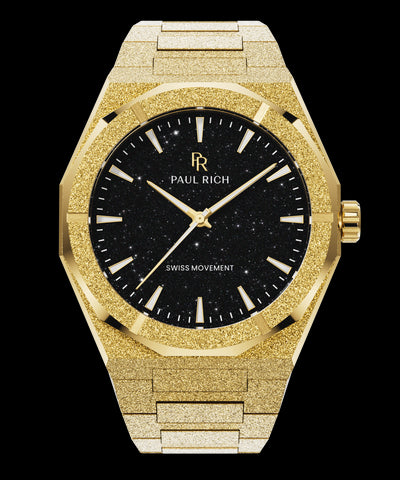
The frosted finish is the signature Paul Rich technique. Rose gold coating over that texture creates a warmth that smooth PVD can't replicate — each facet refracts the tone slightly differently depending on the angle, giving the watch a dimensional quality flat surfaces don't have.
Frosted Star Dust II Void Rose Gold ($389)
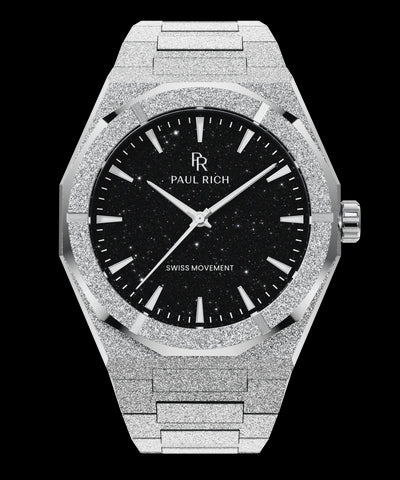
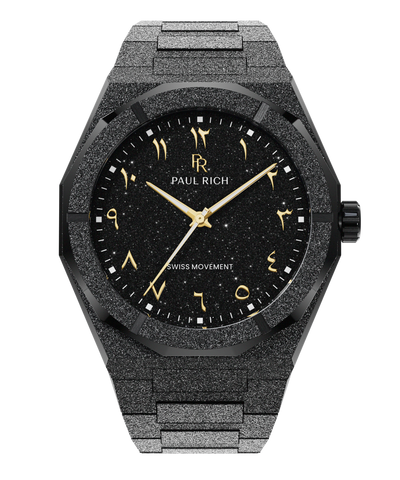
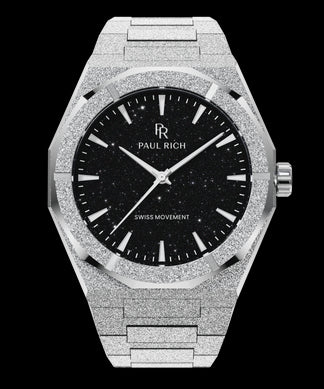
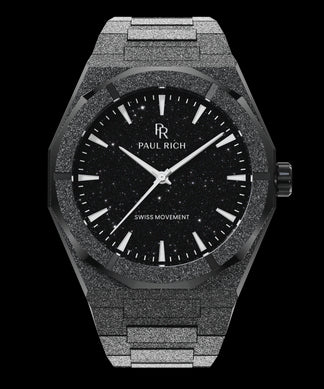
Same frosted 43mm case in rose gold, but the dial swaps from blue to black aventurine. Black aventurine is harder to produce — the mineral inclusions are subtler, the base stone darker, and the visual effect is a dial that shifts between deep black and dark green depending on the light. Paired with the rose gold frosted case, it creates a high-contrast look: warm metal, dark stone. The pick for men who want rose gold presence without a bright dial.
Iced Star Dust II Rose Gold (from $599)
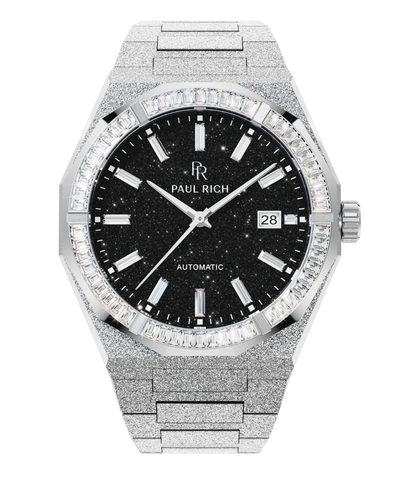
The top of the rose gold Star Dust range. The Iced version takes the 43mm case and adds crystal-set details to the bezel, pushing visual intensity higher. Available in quartz ($599) and automatic ($749). The automatic is the most fully-featured rose gold watch in the collection — mechanical movement, exhibition caseback, aventurine dial, and the iced finishing that gives the bezel its name.
Choosing Between Them
The decision tree is straightforward. Dressier pave look at the lowest price? Crown Legacy, $299. Classic aventurine-and-metal without texture effects? Star Dust II, $339. Frosted surface that defines the brand? Frosted Star Dust II from $389. Darker, higher-contrast dial? Void Rose Gold, $389. Maximum detail and a mechanical movement? Iced Star Dust II from $599.
All share the same core: rose gold PVD over stainless steel, aventurine stone dials (not printed), and case weight that sits on the wrist with presence.
The Bottom Line on Men's Rose Gold Watches
Rose gold works on men's watches because it does something useful that steel and yellow gold don't: it adds warmth without volume, contrast without clash, and presence without dominating an outfit. Whether you're buying a $300 PVD-coated watch or a $30,000 solid gold Rolex, the appeal is the same — a tone that reads as intentional.
If you've been wearing steel exclusively, a rose gold watch is probably the biggest visual upgrade you can make to your wrist without changing anything else about how you dress. It pairs with navy, grey, black, white, earth tones, and patterned shirts. It holds up in formal and casual settings. And unlike yellow gold, it doesn't carry the baggage of trying too hard.
Start with what fits your budget, wear it for a month, and see how many compliments land. That usually settles the debate.