
What Makes a Watch "Automatic"?
Pick up an automatic watch and tilt it. You'll feel something shift inside — a weighted metal disc called a rotor, spinning freely on a bearing. That rotor is the whole trick. Every time your wrist moves, the rotor swings and winds the mainspring, a coiled strip of metal that stores energy like a compressed spring. No battery. No manual winding (though you can do that too). Just the motion of living your day.
The concept dates back to the 1770s, when Swiss watchmaker Abraham-Louis Perrelet built the first self-winding pocket watch. But it took until 1931 for Rolex to patent the first reliable automatic wristwatch movement with a rotor that spun 360 degrees. That basic architecture — rotor, mainspring, gear train, escapement — hasn't changed since. It's been refined, miniaturized, and decorated, but the physics are identical.
Here's the honest truth about automatic watches: they're less accurate than a $15 quartz. They lose or gain a few seconds per day. They stop if you leave them in a drawer for 40 hours. And they cost more to maintain. People don't buy them for precision — they buy them because there's something satisfying about wearing a machine that runs on movement alone.
The Key Components — What's Actually Moving Inside
The Rotor
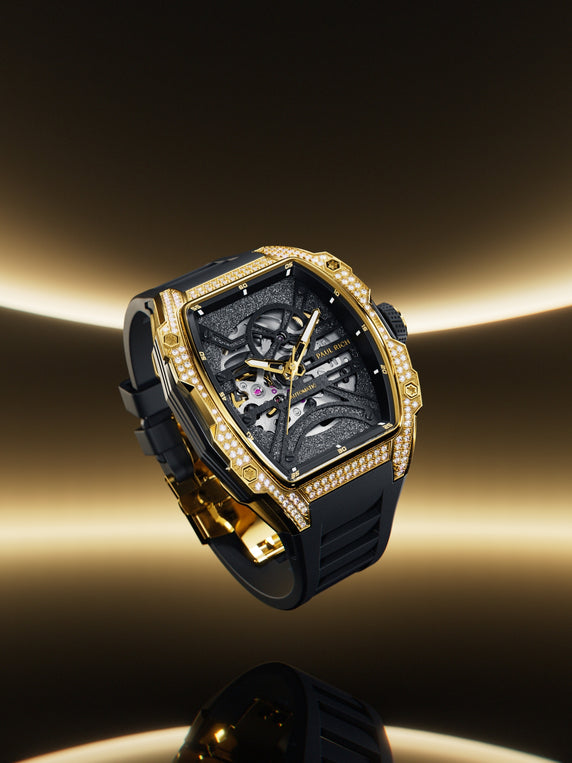
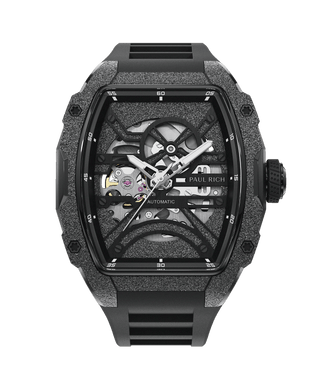
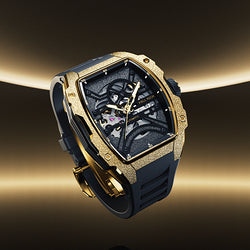
The rotor is a semicircular weight, usually made from tungsten or brass, mounted on a ball bearing at the center of the movement. It swings freely in both directions. In a bidirectional winding system — which most modern automatics use — both clockwise and counterclockwise swings transfer energy to the mainspring. You can see the rotor through a transparent case back, and it's often the first thing people notice. On the Astro Skeleton, the rotor is visible through the open dial itself, spinning against frosted baseplates as you move.
The Mainspring
This is where energy lives. The mainspring is a thin, flat coil of special alloy steel housed inside a barrel. As the rotor winds it tighter, it stores potential energy. As it unwinds, it releases that energy at a controlled rate through the gear train. A fully wound mainspring on most movements holds about 38 to 42 hours of power reserve — enough to keep running through a night on your bedside table and into the next morning.
The Gear Train
Four gears connect the mainspring barrel to the escapement. Each gear steps down the speed and steps up the torque, like shifting gears on a bike. The final gear in the chain — the fourth wheel — makes one full rotation every 60 seconds, which is why the seconds hand sweeps smoothly instead of ticking. That sweep is the visual signature of a mechanical watch.
The Escapement and Balance Wheel
This is the brain of the watch. The escapement is a tiny lever with two pallets that rock back and forth, letting exactly one tooth of the escape wheel pass with each tick. The balance wheel — a weighted wheel on a hairspring — oscillates at a fixed rate, usually 21,600 or 28,800 vibrations per hour (3 Hz or 4 Hz). That oscillation is what divides time into equal intervals. Without it, the mainspring would just unwind all at once.
Think of it this way: the mainspring provides the power, the gear train transmits it, the balance wheel regulates it, and the escapement releases it in measured doses. Every component depends on every other component. Remove any one piece and the whole system stops.
The Jewels
When a spec sheet says "21 jewels" or "24 jewels," those are synthetic rubies set at friction points in the movement — pivot holes, pallet stones, impulse pins. Ruby is extremely hard and smooth, so metal shafts spinning inside ruby bearings last decades without wearing down. More jewels generally means more points of reduced friction, though anything above 25 is usually decorative.
How an Automatic Watch Actually Keeps Time
Here's the full sequence, from wrist movement to ticking seconds hand:
- You move your wrist. Walking, typing, reaching for a coffee — any motion works.
- The rotor swings. Gravity pulls the weighted half-disc downward, and your wrist movement rotates it around its bearing.
- Reversing gears translate rotation into winding. Whether the rotor spins left or right, a set of small gears converts that motion into one-direction winding of the mainspring.
- The mainspring coils tighter. More stored energy. Once fully wound, a slipping bridle prevents over-winding — so you can't damage the spring by moving too much.
- The mainspring slowly unwinds, releasing energy through the barrel into the gear train.
- The gear train steps the speed up, spinning each successive wheel faster until the escape wheel turns at the right rate.
- The escapement releases one tick at a time. The pallet lever catches and releases escape wheel teeth at the rate set by the balance wheel.
- The balance wheel oscillates back and forth, 6 to 8 times per second, regulated by its hairspring. This is the heartbeat of the watch.
- The hands move. The gear ratios are calculated so the center wheel turns once per hour (minute hand), and a 12:1 reduction drives the hour hand.
The entire chain runs continuously. There's no on/off switch. As long as there's tension in the mainspring, the watch runs. When the spring fully unwinds — typically after 38 to 42 hours without movement — the watch stops.
How to Care for Your Automatic Watch
Wearing Habits
An automatic watch needs motion to run. If you wear it daily, it will stay wound without any thought. Most movements reach full wind after about 8 hours of normal wrist activity. If you rotate between multiple watches, the ones sitting still will stop after their power reserve runs out — usually a day and a half to two days.
That's completely normal and causes no damage. The watch doesn't "wear out" from stopping and starting. Just pick it up, give it 20 to 30 manual winds via the crown, set the time, and put it on.
Manual Winding
Every automatic watch can also be wound by hand. Unscrew the crown (if it's a screw-down crown), pull it to the first position, and turn it clockwise. You'll feel slight resistance as the mainspring coils. About 20 to 30 full turns brings most movements to full power reserve. You can't over-wind it — the slipping bridle mechanism disconnects the rotor from the mainspring barrel once it's fully wound.
Power Reserve Management
If you know you're taking the watch off for a day or two, give it a few manual winds before setting it down. This buys you extra hours before it stops. Some people use automatic watch winders — motorized cradles that slowly rotate the watch — but they're not necessary unless you own several automatics and want them all ready to go at a moment's notice.
Service Intervals
A mechanical movement has dozens of parts under constant friction and tension. The lubricants inside dry out over time, and metal surfaces develop microscopic wear. Most manufacturers recommend a full service every 5 to 7 years — disassembly, cleaning, re-lubrication, regulation, and reassembly. Expect to pay $150 to $300 for a standard service on a basic automatic movement. Skipping service doesn't kill the watch immediately, but accuracy degrades and wear accelerates.
What to Avoid
- Strong magnets. Speakers, laptop clasps, magnetic phone mounts — these can magnetize the hairspring and cause the watch to run fast. Most modern movements use anti-magnetic hairsprings, but older or budget movements are vulnerable.
- Hard impacts. The balance wheel staff is one of the thinnest parts in the movement. A sharp knock — dropping the watch on tile, slamming your wrist on a table — can bend or break it.
- Setting the date between 9 PM and 3 AM. On watches with a date complication, the date-change mechanism engages during these hours. Manually changing the date while the gears are already partially engaged can strip teeth. Set the date during daytime hours.
- Water exposure beyond the rating. A 5 ATM rating handles rain and hand-washing, not swimming. If you want a watch you can actually dive with, look for 200m ratings — like the Aquacarbon Pro with its 200-meter depth rating and screw-down crown.
Automatic vs Manual-Wind vs Quartz
These are your three options for watch movements, and each has real trade-offs. No movement type is objectively "best" — it depends on what you value.
| Automatic | Manual-Wind | Quartz | |
|---|---|---|---|
| Power source | Wrist movement (rotor) | Hand winding (crown) | Battery |
| Accuracy | +/- 5-15 sec/day | +/- 5-15 sec/day | +/- 15 sec/month |
| Power reserve | 38-42 hours typical | 42-48 hours typical | 2-3 years (battery life) |
| Maintenance | Service every 5-7 years | Service every 5-7 years | Battery swap every 2-3 years |
| Thickness | Thicker (rotor adds height) | Thinnest mechanical option | Can be very thin |
| Seconds hand | Smooth sweep | Smooth sweep | Tick-tick-tick |
| Daily ritual | Wear it and forget it | Wind every morning | None |
| Price range | $200 - $500,000+ | $200 - $500,000+ | $10 - $5,000+ |
Automatic is the most popular mechanical option because it's self-sustaining. Wear it, and it winds itself. The downside is thickness — the rotor mechanism adds roughly 2-3mm to the case height compared to a manual-wind movement — and the fact that it stops if you don't wear it for a couple of days.
Manual-wind is the purist's choice. There's a daily ritual to it — you wind the crown every morning like winding a clock. These movements can be thinner because there's no rotor, which is why many dress watches use them. The trade-off is obvious: forget to wind it, and it stops.
Quartz wins on accuracy and convenience, period. A $50 quartz watch keeps better time than a $50,000 mechanical. It never needs winding, rarely needs maintenance beyond a battery swap, and it just works. What it doesn't have is the mechanical fascination — the visible engineering, the sweep of the seconds hand, the knowledge that hundreds of tiny parts are working together on your wrist. For more on this comparison, read our Automatic vs Quartz Watches guide.
Automatic Watches at Every Price Point
The automatic watch market spans from $200 microbrands to six-figure complications. Here's what your money actually buys at different levels — and where Paul Rich fits in.
Under $500: Entry-Level Automatics
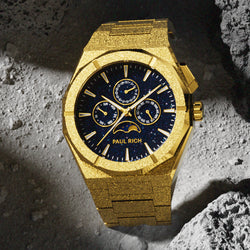
At this price, you're getting reliable Japanese movements (Seiko NH35A, Miyota 8215) in well-finished cases. The Astro Skeleton sits here at $499 — a 42.5mm frosted stainless steel tonneau case with a full skeleton dial that puts the movement on display. The case shape breaks from the standard round form, and you can see the frosted baseplates and bridges working in real time through both the dial and the open case back. Mineral crystal glass, 5 ATM water resistance, and a black silicone strap with anti-static coating.
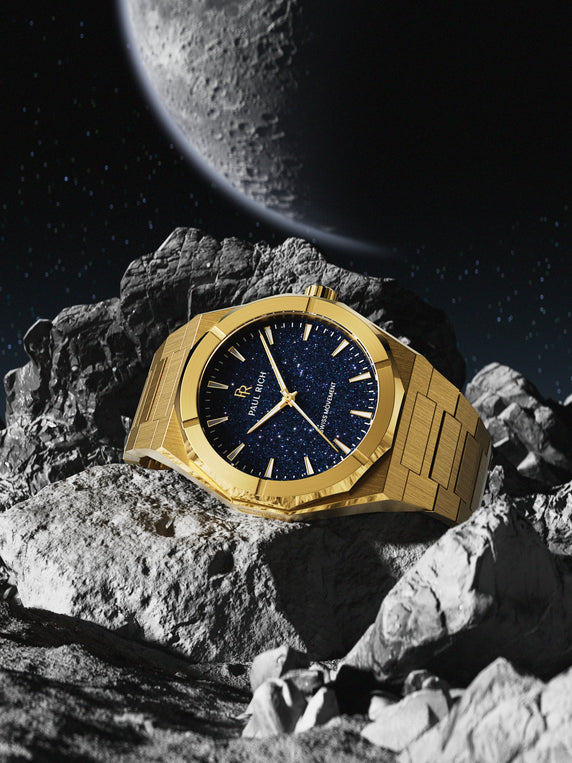
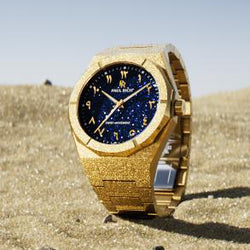
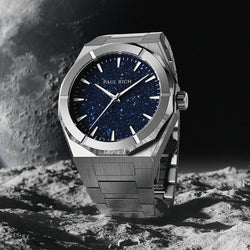
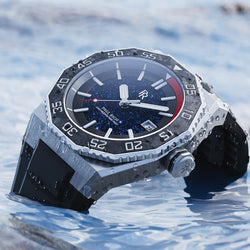
Also in this range: the automatic variant of the Aquacarbon Pro at $499. This one runs on a Seiko NH35A — one of the most proven automatic movements in this segment, known for reliability and easy serviceability. The 43mm case combines forged carbon fiber with stainless steel, carries an aventurine dial (natural glass filled with metallic crystals that shimmer in light), and backs it up with sapphire crystal and a serious 200-meter water resistance rating. At 103 grams on a rubber strap, it's lighter than most dive watches at any price.
$500 to $1,000: Mid-Range Automatics
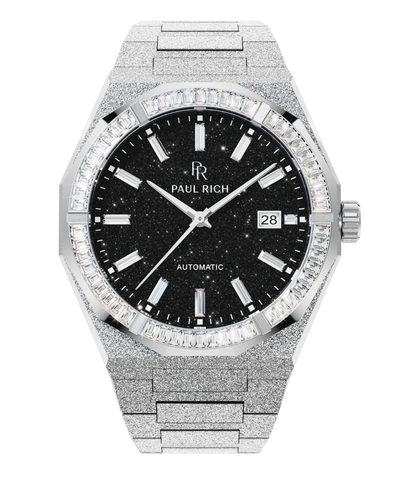
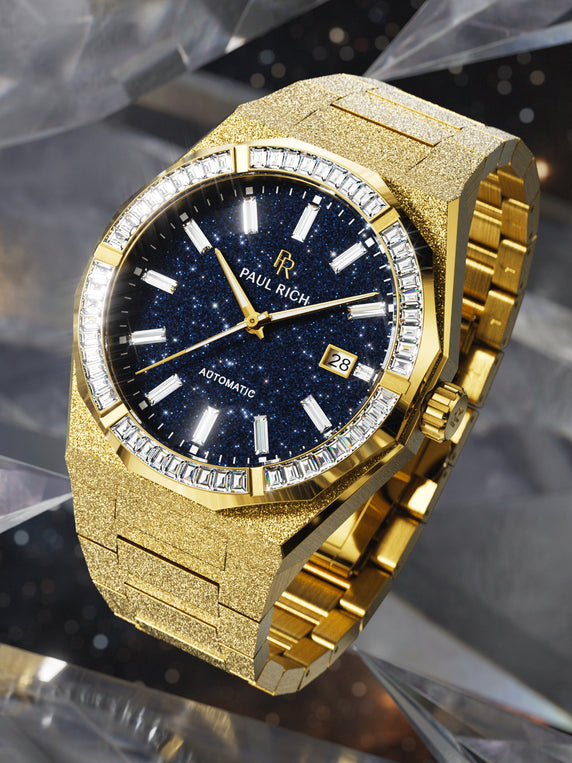
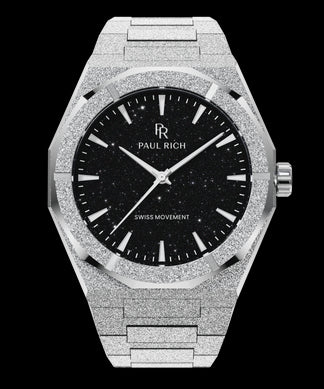
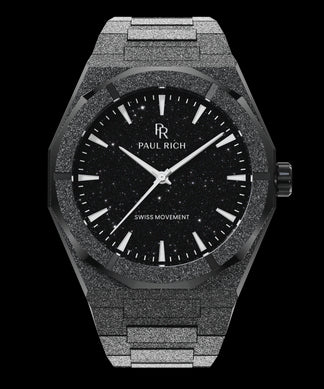
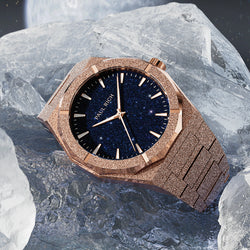
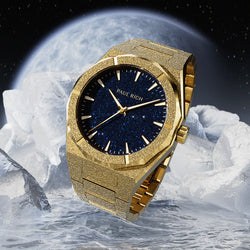
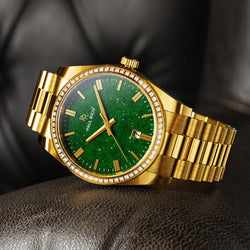
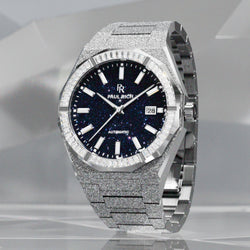
This is where materials and finishing start to escalate. You get sapphire crystals standard, better case finishing, and sometimes premium dial materials. The Moissanite Frosted Star Dust II in automatic at $1,049 demonstrates what this bracket can deliver. The 43mm frosted case is carved with thousands of micro-facets that scatter light at rest. The bezel and dial carry 5.67 carats total weight of hand-cut moissanites in a continuous pave field over a black aventurine base — a natural glass filled with microscopic metallic crystals that creates extreme contrast with the stones above it. Sapphire-coated glass, 5 ATM resistance, and your choice of quartz or automatic movement.
$1,000 to $2,000: Premium Automatics
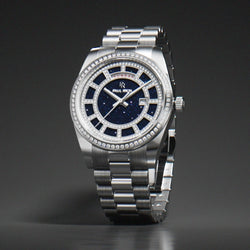
Lab-grown diamonds, higher-grade finishing, and sapphire crystal become baseline. The Diamond Astro Skeleton at $1,499 puts hand-set, lab-grown VVS diamonds on the bezel of the tonneau skeleton case. Sapphire crystal glass protects the open dial, through which every gear and spring is visible. The same 42.5mm case dimensions as the standard Astro Skeleton, but the diamond bezel and sapphire upgrade move it into a different category of wrist presence. For more on what lab-grown stones bring to the table, read Why Lab-Grown Stones Are the Future of Luxury.
$2,000 and Above: Established Brands
Above $2,000, you enter Swiss-made territory — brands like Tissot, Hamilton, Longines, Oris, and Tudor. You're paying for Swiss-made movements (ETA, Sellita), COSC chronometer certification on some models, more elaborate finishing techniques, and brand heritage. The movements are often better regulated out of the box (+/- 4-6 seconds per day vs. +/- 10-15 for entry-level), and case finishing reaches a higher polish and brushing standard. Whether that difference justifies the jump from $500 to $2,500+ depends entirely on your priorities.
Is an Automatic Watch Worth It?
If you're asking purely about timekeeping accuracy, no. Your phone, your quartz watch, even a $30 Casio will keep better time. Automatic watches are worth it for different reasons.
They're mechanical objects in a digital world. Hundreds of parts, assembled and regulated by hand, running entirely on physics — no electricity, no circuits, no software updates. There's something grounding about that. You maintain a relationship with the watch: you notice when it's running fast, you wind it when it stops, you feel the rotor spin when you gesture.
They also hold up differently over time. A quartz movement from 2006 works fine, but nobody talks about it. An automatic watch from 2006 — properly serviced — has patina, has a story, has parts that have been working together for two decades. It's a machine with a lifespan measured in generations, not battery cycles.
The practical answer: if you want something that just tells time, buy quartz. If you want something you'll actually think about, pick up, examine, and maintain — an automatic watch gives you that. For a fuller breakdown of the trade-offs, check out our comparison of automatic vs quartz movements.